
ORGASMOLOGY
Orgasmology -
A New Discipline
The Interdisciplinary Study
of How We Become Orgasmic
Orgasmology is the interdisciplinary study of orgasmic capacity: how orgasm is accessed, experienced, learned, strengthened, generalized, transferred, and expanded through genital and non-genital pathways.
The Orgasmology Framework and Orgasmic Learning
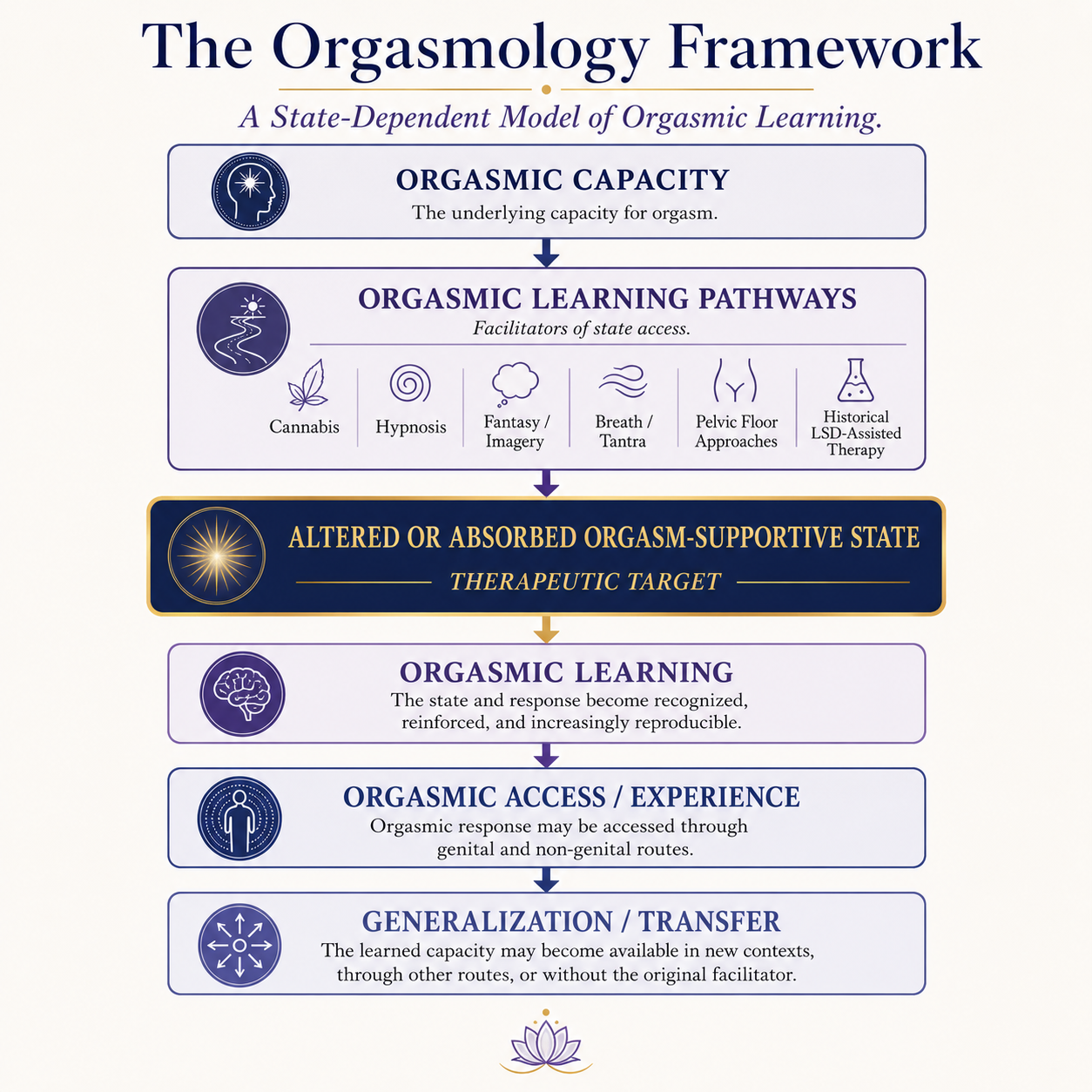
The Orgasmology Framework shown above presents a state-dependent model of orgasmic learning.
Within this framework, research-supported orgasmic learning pathways facilitate access to an altered or absorbed orgasm-supportive state. Orgasmology focuses on this state as the therapeutic target.
Although orgasmic learning pathways differ in how they facilitate state access, they share a common function: helping a woman enter the state in which orgasmic learning becomes possible. Within that state, orgasmic learning occurs, orgasmic response becomes accessible through genital and non-genital routes, and the learned capacity may subsequently generalize or transfer beyond the conditions in which it was first acquired.
Click here to see how the orgasmology framework and orgasmic learning is applied in training.
The Origins of Orgasmology
In 1982, French sociologist André Béjin used the term “orgasmology” critically to describe what he saw as a transformation in modern sexology. He argued that orgasm had become sexology’s “central problem” and a measure of sexual functioning. In a companion article, Béjin described how an “ideal orgasm” had become a normative standard around which sexology developed classifications of orgasmic dysfunction and behavioral “orgasmotherapies.”¹ ²
Nearly a decade later, at the First International Conference on Orgasm in New Delhi in 1991, John Money, PhD, a psychologist and sexologist at Johns Hopkins University, reclaimed the term positively. In his paper, “Orgasmology, the Science of Orgasm: Brain, Genitals, Phantom Orgasm, Clinical Syndromes,” Money argued for giving the scientific study of orgasm greater legitimacy and placing orgasm itself at the center of scientific inquiry. He called for the study of orgasm to become a distinct discipline: Orgasmology.³
More than three decades later, no sustained scientific or professional discipline dedicated specifically to orgasm had emerged.
Why it Matters
More than three decades after Orgasmology was proposed as a distinct scientific discipline, the need remains substantial.
- The DSM-5-TR reports prevalence estimates for orgasm problems among premenopausal women ranging from 8% to 72%.⁴
- Long-term population research found no improvement in female orgasmic capacity from the 1970s through 2015.⁵
- A comprehensive review concluded that treatment for Female Orgasmic Disorder had seen little innovation since the 1980s.⁶
- Research on orgasm remains distributed across multiple disciplines rather than organized around orgasm as a field of study in its own right.
Orgasmology brings this work together around orgasmic capacity, state, learning, pathways, access, generalization, and transfer.
Our Role
The Female Orgasm Research Institute (FORI) is establishing and advancing Orgasmology as a scientific and professional discipline. FORI is:
- Conducting and publishing peer-reviewed research on female orgasmic function and orgasmic learning.
- Developing the Orgasmology Framework and state-dependent models of orgasmic learning. • Advancing research into orgasmic learning pathways, including cannabis-assisted orgasmic learning.
- Integrating findings across neuroscience, psychology, sexual medicine, sexology, physiology, pharmacology, and related fields.
- Establishing the scientific foundation for professional education, standards, and future practice in Orgasmology.
Supporting the development of professional standards and a future professional association for the emerging field of Orgasmology.
References
1. Béjin A. Crépuscule des psychanalystes, matin des sexologues. Communications. 1982;35:159-177. doi:10.3406/comm.1982.1531.
2. Béjin A. Le pouvoir des sexologues et la démocratie sexuelle. Communications. 1982;35:178-192. doi:10.3406/comm.1982.1532.
3. Money J. Orgasmology, the Science of Orgasm: Brain, Genitals, Phantom Orgasm, Clinical Syndromes. In: Kothari P, Patel R, eds. Proceedings of the First International Conference on Orgasm, February 3-6, 1991, New Delhi. Bombay, India: VRP Publishers; 1991.
4. American Psychiatric Association. Diagnostic and Statistical Manual of Mental Disorders, Fifth Edition, Text Revision (DSM-5-TR). 2022.
5. Kontula O, Miettinen A. Determinants of female sexual orgasms. Socioaffective Neuroscience & Psychology. 2016;6:31624.
6. Marchand E. Psychological and Behavioral Treatment of Female Orgasmic Disorder. Sexual Medicine Reviews. 2021;9(2):194-211.